 I expect you to hate me from time to time. It is part of the process. Some people come around at some point. Some sooner than others. The ones that come around tell me that after a while they actually … Continue reading
View article:
I expect you to hate me from time to time. It is part of the process. Some people come around at some point. Some sooner than others. The ones that come around tell me that after a while they actually … Continue reading
View article:
I have run out of good shows to watch on Netflix. I began to watch and abandoned four shows, fast. And I just had an insight: Most TV/Netflix customers are like most people: they have no foundation from which to … Continue reading →
Read more here:: https://yourvibration.com/29172/29172/
 There’s so much you want to learn, need to learn, should learn… so much, in fact, that you don’t know where to start.
Most people get inspired for some goal, sprint at max effort for 1-2 weeks, burn out, push the goal into the back of their mind, and never touch it again. New Year’s resolutions are a classic example. Campaigning.
Let’s look at how to improve your chances of success.
The first thing you should do is touch base with yourself. Ask: “Is what I want what I want?”
I know that is a funky question… of course… but ask it anyway! It may not be necessarily so!
Sometimes, we lie to ourselves about what we want. Other times, we are being deceived and we don’t even know it. We might want to do something because of vanity, because our neighbors are doing it, because of our self-identity, or because of some long-held ‘dream’ from childhood.
Begin by doubting yourself. Find the things you actually want – not the things you say you want. It will save a lot of time on the long run.
Next, you need to make space. Before you decided to change, your day is already full. You slept, ate, work and did stuff — 24 hours a day, every day. To make room for new things, something else will have to go. There is always a sacrifice.
In an ideal world, we would surgically remove bad habits, activities, people that are least in line with our goals and add in only those things most in line with the goals. Sadly, behavioral change isn’t quite that precise. But that doesn’t mean we can’t be systematic about it.
Again, remember that making space is hard. You will only be able to do one new thing, two at most.
Choose the most important thing, spend 1-2 weeks making that practice into a habit, then repeat the above process for new changes you want to make.
How to choose the “most important thing?” By choosing the lead domino.
I heard of this concept from Tim Ferriss. When you have a lot of interesting things ahead of you and you don’t know what to choose, choose the thing that makes everything easier. If you want to run a marathon, you might want to start by quitting smoking first. If you want to be a martial artist, you might want to “bulletproof” your joints against injury so you can train harder.
A few more tools before you go.
It takes very little, maybe 15 minutes 3 times a week, to maintain a skill. This prevents regression, which is costly. Forgetting a language and then relearning it costs a lot more than keeping it on maintenance.
Try scheduling reloads for your own daily practice. Let to subconscious do its work. Go on vacation every one or two months. Take a day off. Read some fiction. You might find it easier to concentrate after you come back.
Source:
Read the original article: How to Learn Many Things at Once… very useful if you are in my coaching program
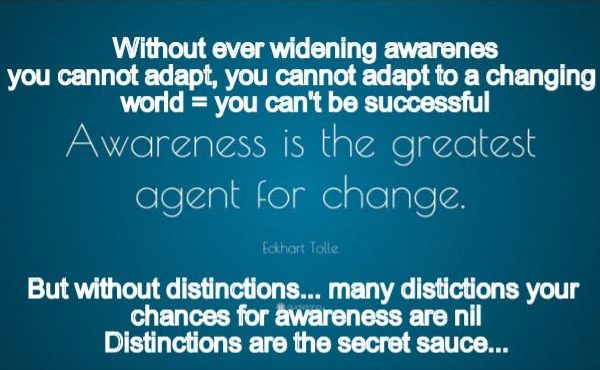 Changeability, adaptability is the secret of living a consistently good life… but changeability and adaptability depend on awareness. As your awareness grows in the four pillars of the good life, so your success and the quality of your life…
By the way, did you notice I didn’t say “learn about awareness…” but that is what you read? Right?
In the old Forum program, the Forum Leader came in, screaming at us, poor unsuspecting brand new participants: For you everything is the same as everything else.
It took me years to decipher that and see that it is true.
Continue reading
 Changeability, adaptability is the secret of living a consistently good life… but changeability and adaptability depend on awareness. As your awareness grows in the four pillars of the good life, so your success and the quality of your life… By … Continue reading
Read article here –
Learn awareness, the strongest indicator of health, wealth, love, and happiness
 There is not much in common. It is not talent. It is not ethnicity. Not personality. Not schooling. Not religious affiliation.
The one common characteristic I have found is books. People who become worth a damn are readers.
Even more importantly than being a reader: the most important commonality is when they started to read.
Continue reading
 I caught something today:
Prostitution. Your base survival strategy.
What is prostitution?
Let’s look at it without a dictionary, shall we?
Let me now check what the dictionary has to say about it?
The unworthy or corrupt use of one’s talents for the sake of personal or financial gain.
 Creativity comes from the “other than conscious” activity of the brain. The part that is neither linear nor word based.
I spend a large chunk of the day allowing it to do what it does…
It is allowing whatever is going on in the brain and in the body to go on… The best way is to make yourself busy.
Washing the dishes, vacuuming, doing the laundry, walking, or playing Freecell…
One of the useless things Tai teach is what he calls armchair meditation. He wants you to do serious linear thinking… which is proven to be a lot less accurate than your other than conscious brain doing the work unattended.
Continue reading
Do you know what no feelings mean? You are dead… While you are alive life is ups and downs, good feelings, bad feelings, neutral feelings.
The fact that you can’t feel your feelings doesn’t mean they aren’t there…
Yesterday was a weird day.
First I fell victim to taking things personally. I’d like to say it was funny, but taking things personally is not fun.
The whole day passed without a single email, and also without most of my regular clients and students visiting my site. I was checking.
Late afternoon I started to contemplate that I have lost my customers.
Then I looked if I could handle that…
Continue reading
 I’ve done a remarkable experiment.
It’s been remarkable because I didn’t mean to do it.
It’s been remarkable because what I’ve seen.
A week ago I got a “message” from Source, whatever that is, to stop doing the 67 steps. It suggested that something else should be started, but no indication of what that “something else” was going to be.
It’s just one week after.
Nothing has replaced the practice of doing the 67 steps.
I am sitting by my computer, and suddenly the thought floats up with the all too familiar feeling: “I should die. It’s not worth living.” Continue reading